

Software Development
Cuanto Cuesta una Pagina Web en 2026: Precios Reales
You ask five companies for a quote to "build a website" and get figures from 700 to 40,000 euros. They all say they do the same thing.
 Adrian Sobota
How much does a website cost in 2026? It’s the question every business owner asks before taking the leap. You ask five companies for a quote to “build a website” and get figures from 700 to 40,000 euros. They all say they do the same thing. None of them explain why there’s such a big difference.
If you’re looking up how much a website costs or what a web app runs in 2026, that frustration is the starting point. And it makes perfect sense: the market is full of absurdly wide ranges that mean nothing if you don’t understand what’s behind each number.
This article gives you what others don’t: real prices broken down by project type, explained so you understand what each range includes, what factors drive the price, and what you should expect from the process. No unnecessary jargon, with the actual numbers we use in our own development studio.
Let’s get to it.
Website vs Web App: Not the Same Thing
Before we talk about how much a website costs, there’s a distinction most articles ignore that completely changes the budget.
A website is an informational site: it shows who you are, what you do, and how to reach you. It has static pages, maybe a blog. It’s what most small businesses need to get started.
A web app is a different animal. It has business logic: users sign up, dashboards, complex forms, payments, integrations with other systems. Think Notion, Trello, or your online banking dashboard. That’s a web app.
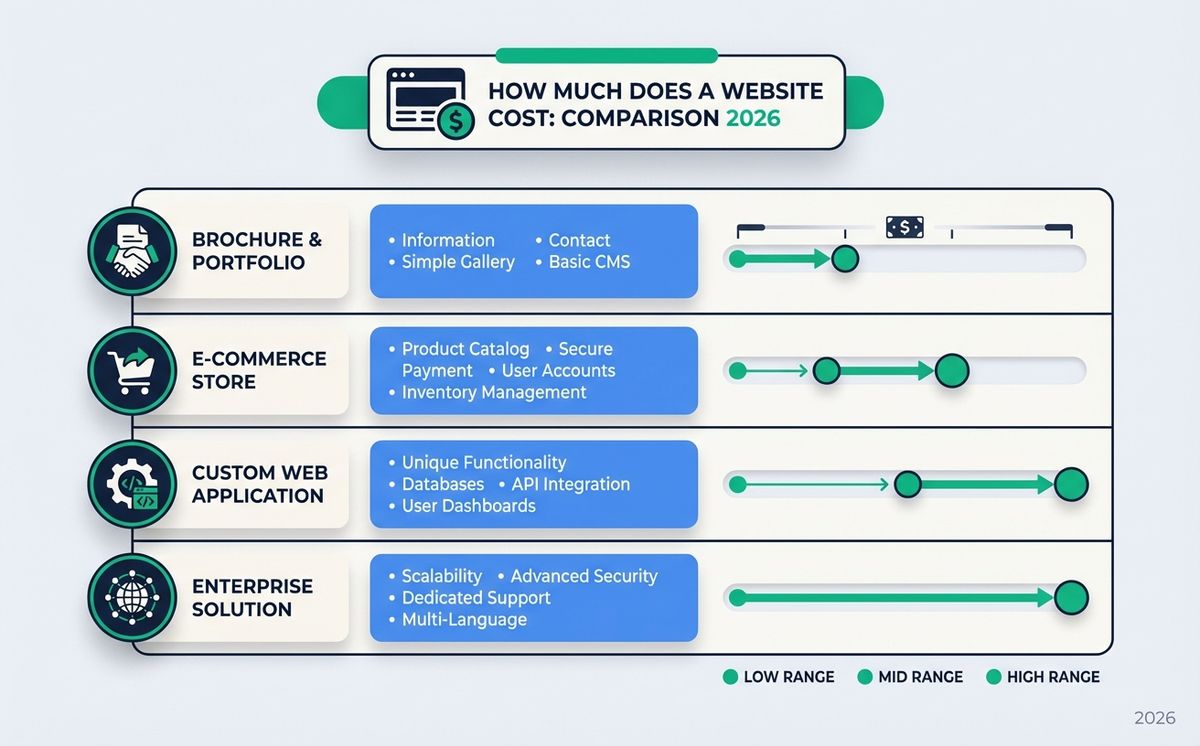
- Simple corporate website (700-1,500 euros): 3-5 informational pages
- Website with SEO and content (1,500-4,000 euros): Optimized blog, ranking strategy
- Online store (2,000-8,000 euros): Ecommerce with payment gateway
- Custom web app (3,000-15,000+ euros): Dashboard, SaaS, platform with users
- MVP to validate an idea (400-2,000 euros): Minimum functional version
The difference between asking for “a website” and asking for “a web app with authentication, user roles, and a payment gateway” is, literally, a 10x factor in price. If those five agencies gave you different prices, it’s probably because each one understood something different about what you need.
Marina, who owns a physiotherapy clinic, reached out to us in February 2026 after getting quotes from four providers. “One told me 800 euros, another 12,000. I felt ripped off without knowing by whom.” When we reviewed what she actually needed (a corporate website with an online booking system), the answer was clear: 800 euros was for a static site with no booking functionality, and 12,000 was for a full app with an admin panel she didn’t need. Her actual project cost 2,200 euros.
If you want to see our prices directly, they’re published with no surprises on our pricing page.
How Much Does a Website Cost in 2026: Prices by Type
Let’s break down each project type with what’s included and what’s not.
Simple corporate website: 700-1,500 euros
The most basic option. Includes:
- 3-5 pages (home, services, about us, contact)
- Responsive design (mobile-friendly)
- Contact form
- Basic hosting and domain
Not included: Blog, SEO, copywriting, integrations, or advanced functionality. It’s a digital storefront. It does the job if all you need is basic online presence.
Website with SEO and content: 1,500-4,000 euros
Here the site is built to show up on Google. Includes:
- Everything above
- SEO architecture (URL structure, meta tags, sitemap)
- Keyword-optimized copywriting
- Blog with 3-5 initial articles
- Structured data (JSON-LD)
- Performance optimization (Core Web Vitals)
This is the option we recommend for small businesses that want to generate organic traffic. If you’re interested in understanding how SEO works on Google in the AI era, that will give you context on why investing in SEO from day one is worth it.
Online store / ecommerce: 2,000-8,000 euros
A functional ecommerce site with:
- Product catalog
- Shopping cart and checkout
- Payment gateway (Stripe, Redsys)
- Basic inventory management
- Transactional emails
The range depends on the number of products, catalog complexity, and level of customization. A store with 20 products is very different from one with 2,000 and advanced filters.
Custom web app: 3,000-15,000+ euros
This is where real custom web development begins. Projects with:
- User authentication (registration, login, roles)
- Admin panel
- Custom business logic
- Relational database
- APIs and integrations
- Professional deployment with CI/CD
The “+” in the price isn’t decorative. According to Cleveroad’s analysis of web app costs, international ranges go from 20,000 to 500,000 dollars for complex projects. In Spain, thanks to lower operational costs, prices are significantly lower. A SaaS platform with subscriptions, analytics, and multiple integrations can easily exceed 30,000 euros. It all depends on functional complexity.
MVP to validate an idea: 400-2,000 euros
This is the range that surprises people the most. An MVP (Minimum Viable Product) isn’t a complete app. It’s the smallest version that lets you validate whether your idea works before investing more.
At LetBrand we build MVPs starting at 400 euros. It’s not magic: it’s radical prioritization. We build only what’s essential so you can test your idea with real users and make decisions based on data, not assumptions.
What Determines How Much a Website Costs
Understanding the factors that determine how much a website costs and drive your web development budget allows you to negotiate better and spot inflated quotes.
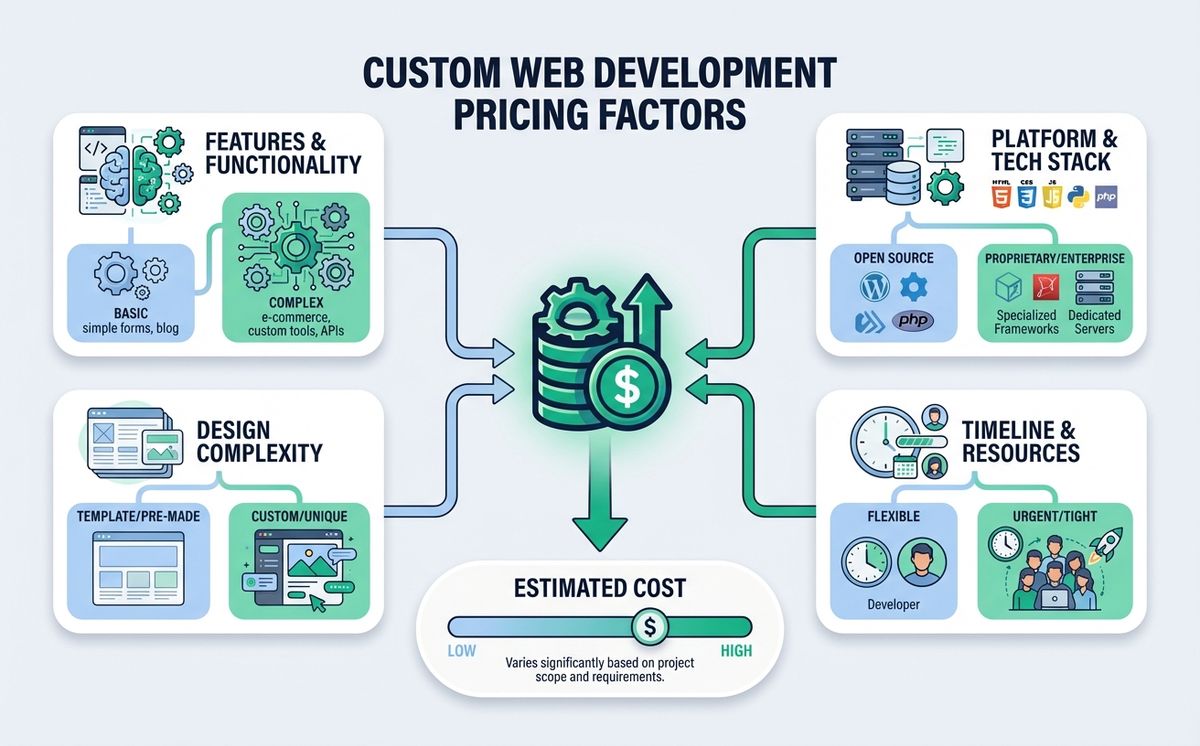
Functional complexity
This is the most important factor. A site that displays information is simple. One that lets users create accounts, upload files, process payments, and generate reports is complex. Each feature adds lots of hours of development, testing, and maintenance.
Custom design vs template
A design from scratch (custom UI/UX) costs between 1,000 and 5,000 additional euros. An adapted template or a design system like shadcn/ui reduces that cost significantly without sacrificing visual quality.
Tech stack
Building with WordPress is not the same as building with Next.js. The stack affects performance, scalability, and long-term maintenance costs. We cover this in detail further down.
Integrations
Connecting your site with payment gateways (Stripe, Redsys), CRMs (HubSpot, Salesforce), email tools (Resend, Mailchimp), or external APIs adds complexity and cost. Each integration can add between 200 and 2,000 euros depending on the API’s documentation and complexity.
SEO and performance
Building with SEO from day one costs more upfront but saves money long-term. Patching a poorly built site to make it fast and rank well always costs more than doing it right from the start.
Freelancer vs Agency vs Studio: How Much Each One Charges
Knowing how much a web developer charges is part of understanding how much a website costs, and it depends heavily on who you work with.
- Freelancer (25-50 euros/hour): Best for simple projects and very tight budgets. Risk: availability and continuity.
- Large agency (80-150 euros/hour): Best for enterprise projects with dedicated teams. Risk: high cost and bureaucracy.
- Specialized studio (40-60 euros/hour): Best for SMBs, MVPs, and custom apps. Risk: limited capacity.
The average rate in Spain is around 38-40 euros/hour for professional web development.
Pablo, founder of a logistics startup, chose a freelancer at 20 euros/hour to build his shipment tracking platform. “The price was unbeatable,” he recalls. Six months later, the freelancer stopped responding. The platform had bugs nobody could fix because there was no documentation or tests. He ended up hiring a studio to rebuild the project from scratch. Total cost: triple what he would have paid if he’d chosen well from the start.
Cheap doesn’t always mean expensive in the long run. But in web development, continuity and post-launch support are worth as much as the code itself. At LetBrand we offer support plans starting at 100 euros/month precisely because of this: most agencies disappear after delivery.
WordPress vs Custom Development: The Million-Euro Question
It’s the inevitable comparison. And the honest answer is: it depends.
WordPress:
- Initial cost: 500-3,000 euros
- Load speed: 2-5 seconds (with plugins)
- SEO: Limited by plugins (Yoast)
- Scalability: Degrades with traffic and plugins
- Maintenance: Constant plugin updates
- Security: Vulnerable (40% of the internet runs WordPress)
- Customization: Limited to the plugin ecosystem
Custom development (Next.js):
- Initial cost: 1,500-15,000+ euros
- Load speed: Sub-second
- SEO: Full control (metadata, structured data, rendering)
- Scalability: Scales horizontally
- Maintenance: Automatic deploy, clean code
- Security: Minimal attack surface
- Customization: Unlimited
When WordPress makes sense for someone wondering how much it costs to build a website: simple blog, corporate site without complex functionality, very tight budget with no growth expectations.
When custom development makes sense: You need performance (Core Web Vitals), professional SEO, custom functionality, scalability, or simply a site that won’t break with every plugin update.
The claim “WordPress is cheaper” is true on day one. In the medium term, maintenance, performance issues, and plugin limitations can make custom development more cost-effective than maintaining a patched-together WordPress site.
There is also a hidden cost most people miss: opportunity cost. A WordPress site that loads in 4 seconds instead of 0.8 seconds loses visitors and rankings every single day. Over a year, that lost traffic can represent thousands of euros in missed business. The “savings” from choosing WordPress often evaporate when you factor in what you are losing.
The Stack We Use and Why It Matters for Pricing
When we talk about custom web development, the tech stack directly affects cost, performance, and maintainability.
At LetBrand we use:
- Next.js + React + TypeScript: Modern framework, server-side rendering, strict typing. Your site loads in under a second and Google indexes it perfectly.
- Supabase (PostgreSQL): Scalable database with built-in authentication. Cuts weeks of development time on user management.
- Vercel: Automatic deployment, preview URLs for every change, global CDN. The same stack used by Notion and the most successful startups. And innovation doesn’t stop: today you can even run AI directly on your device without relying on the cloud.
- Tailwind CSS + shadcn/ui: Consistent design system that reduces frontend hours without sacrificing visual quality.
Why does this matter? Because a modern, well-chosen stack reduces development time, which directly impacts how much it costs to build a web app and lowers the project’s final price. And it produces a result that doesn’t need patches or rewrites six months later.
You can check the performance of any site (yours or a competitor’s) at Google PageSpeed Insights.
What to Expect from the Process: Timelines and Deliverables
Knowing how much it costs to build a website is only half the story. You also need to know how long it takes and what you’ll receive.
Realistic timelines
- Simple corporate website: 2-3 weeks
- Website with SEO: 3-5 weeks
- Ecommerce: 4-6 weeks
- Custom web app: 6-12 weeks
- MVP: 4-6 weeks
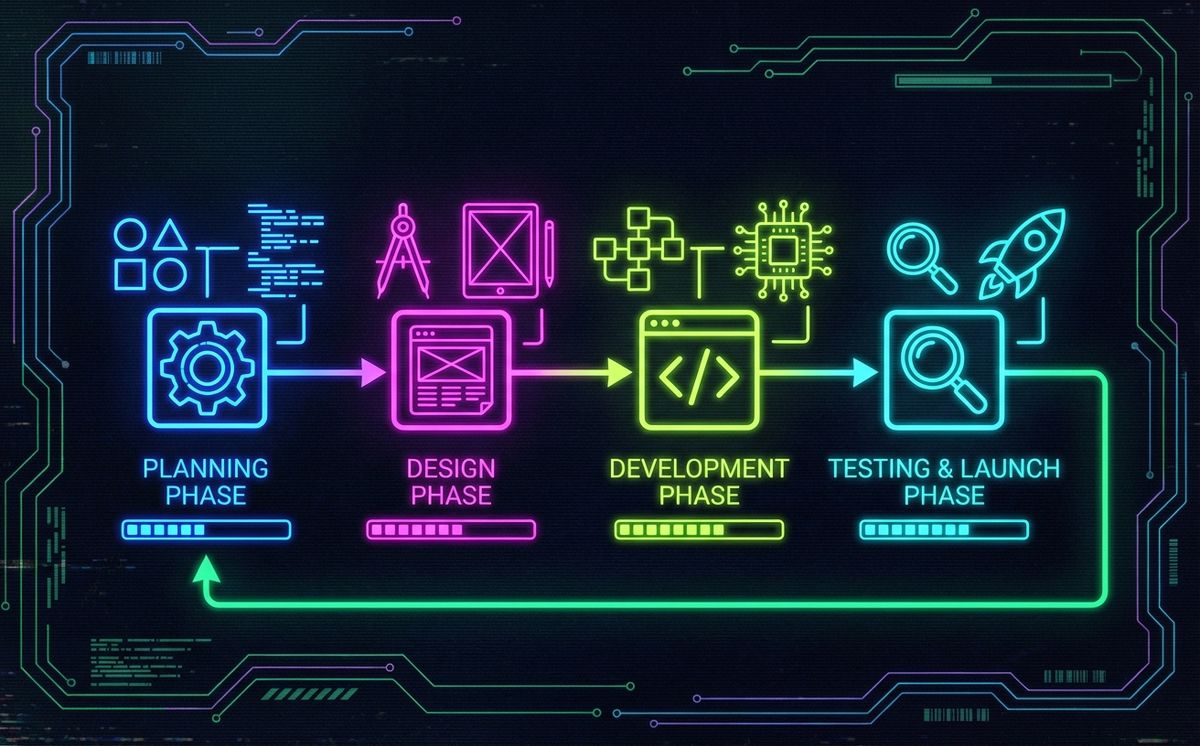
The phases of the process
- Discovery and planning (1-2 weeks): Understand what you need, define scope, choose stack
- Design and prototype (1-2 weeks): Wireframes, visual design, client approval
- Development (2-8 weeks): Building the product, iterations
- Testing and launch (1 week): QA, bug fixes, deploy to production
- Post-launch: Support, improvements, iterations based on real data
Sofia, director of a dental clinic chain, hired an agency that promised her appointment management platform “in 3 weeks.” Eight weeks in, they still hadn’t delivered. “I realized the 3-week timeline was a sales hook, not a real estimate.” The project ended up taking 14 weeks. If someone promises you a complete app in 2 weeks, be skeptical. The timelines above are the real ones.
What This Means for Your Business
If you’re just starting out: An MVP from 400 euros lets you validate your idea with real users before investing thousands. If you’re asking how much a website costs to get started, this is the most pragmatic answer: start small, validate, and scale.
If you have a site that isn’t working: Before scrapping it and starting from scratch, ask yourself: is the problem technical (speed, SEO, bugs) or functional (it doesn’t do what you need)? If it’s technical, an audit and optimization may be more efficient than a complete redesign.
If you need an app with business logic: Custom development. There are no shortcuts. WordPress with 40 plugins isn’t going to scale with you. Invest in a modern stack that grows with your business.
Questions to ask yourself before requesting a quote:
- What does my site need to do that it currently doesn’t?
- How many users will be using it simultaneously?
- Does it need to integrate with other systems?
- What is my actual maximum budget?
- Who will maintain this after launch?
Answering these questions before talking to a provider saves you time, money, and frustration. If you want to explore international cost benchmarks, Hostinger’s real-cost analysis of web apps offers useful context for comparing with Spanish market prices.
Let’s recap:
- A simple corporate website costs between 700 and 1,500 euros
- With integrated SEO, the range goes up to 1,500-4,000 euros
- A custom web app starts at 3,000 euros and scales with complexity
- An MVP to validate your idea can cost as little as 400 euros
- WordPress is cheaper on day one; in the medium term, custom development tends to be more cost-effective
- The average professional development rate in Spain is around 38-40 euros/hour
- Realistic timelines range from 2 weeks (simple site) to 12 weeks (full app)
How much a website costs depends on what you need, not on what an agency wants to charge you. Understand what you’re asking for, compare with criteria, and choose a provider that explains things transparently.
What hasn’t changed in 2026: your website is still the most important digital asset your business has. A good website generates clients, positions your brand, and works for you 24 hours a day. A bad website costs you money every day it’s online. The difference isn’t how much you invest, but who you trust to do it right.
Have a project in mind and want to know how much it would cost? Tell us about your project. 30-minute strategy session, no pitch, no commitment. We tell you what you need, what you don’t need, and how much it costs. With real numbers.
Related Posts

Agent skills are the open standard that works across Claude Code, GitHub Copilot, Gemini CLI, and 45+ AI agents. One file. Every tool. Zero repetition.
Read more
Every match weekend, Spain Cloudflare blocks take down online shops, payment systems and GPS apps. Pirates keep watching. Your business pays the bill.
Read moreReady to start your project?
Let's talk about how we can help your brand grow with a personalized digital strategy.
Contact us