

Cybersecurity
Spain Cloudflare Blocks: Your Sales Drop for La Liga
Every match weekend, Spain Cloudflare blocks take down online shops, payment systems and GPS apps. Pirates keep watching. Your business pays the bill.
 Adrian Sobota
Adriana has been dealing with the same problem for months. Every weekend, her online store goes down. Customers try to buy and can’t. The advertising budget she spent during the week disappears without return. She loses around €1,000 per month, and nobody gives her an explanation that makes any sense.
The explanation exists, but it’s absurd: there’s a La Liga football match on.
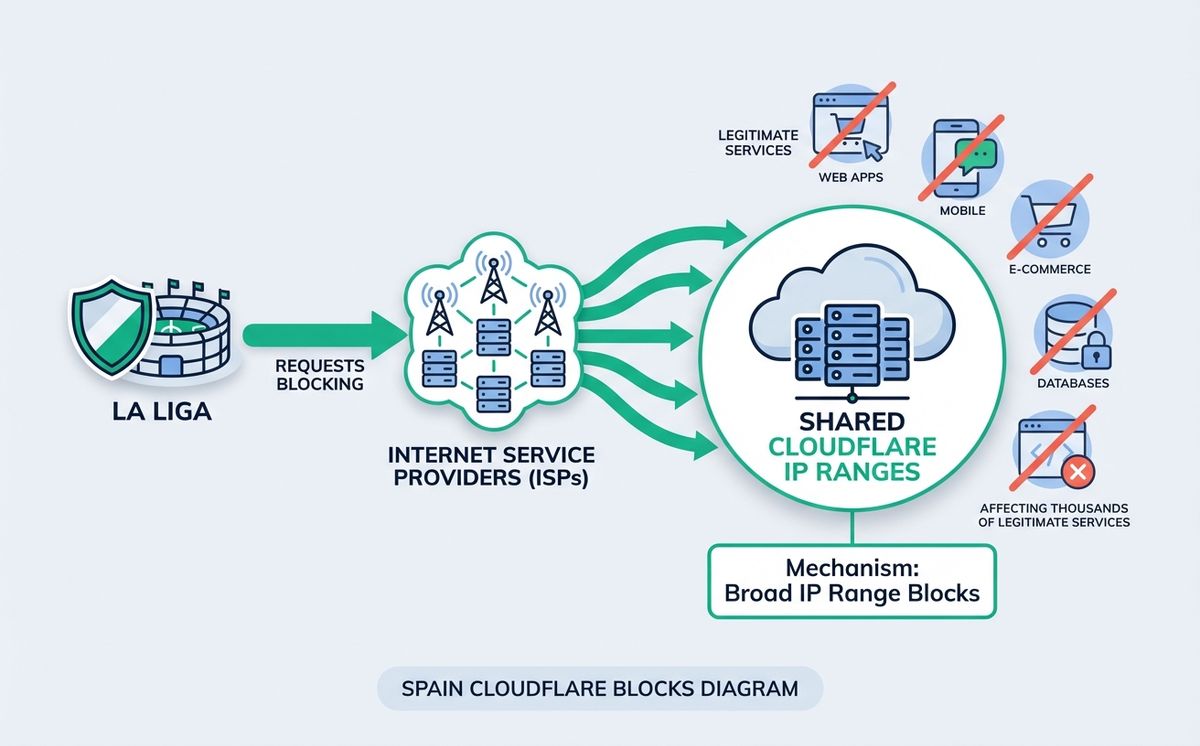
That is what Spain Cloudflare blocks mean in practice. A court ruling obtained by La Liga and Telefónica allows them to block large sections of the internet during live matches, with the stated goal of fighting piracy. The problem is that these blocks don’t only affect piracy sites. They affect thousands of legitimate businesses that have absolutely nothing to do with football.
And the most ironic part: the pirates keep watching the matches without any problem.
If your website goes down on weekends, or if your systems fail for no apparent reason on Saturday afternoons, this article explains exactly what’s happening and what you can do about it.
Spain Cloudflare Blocks Explained: What’s Actually Happening
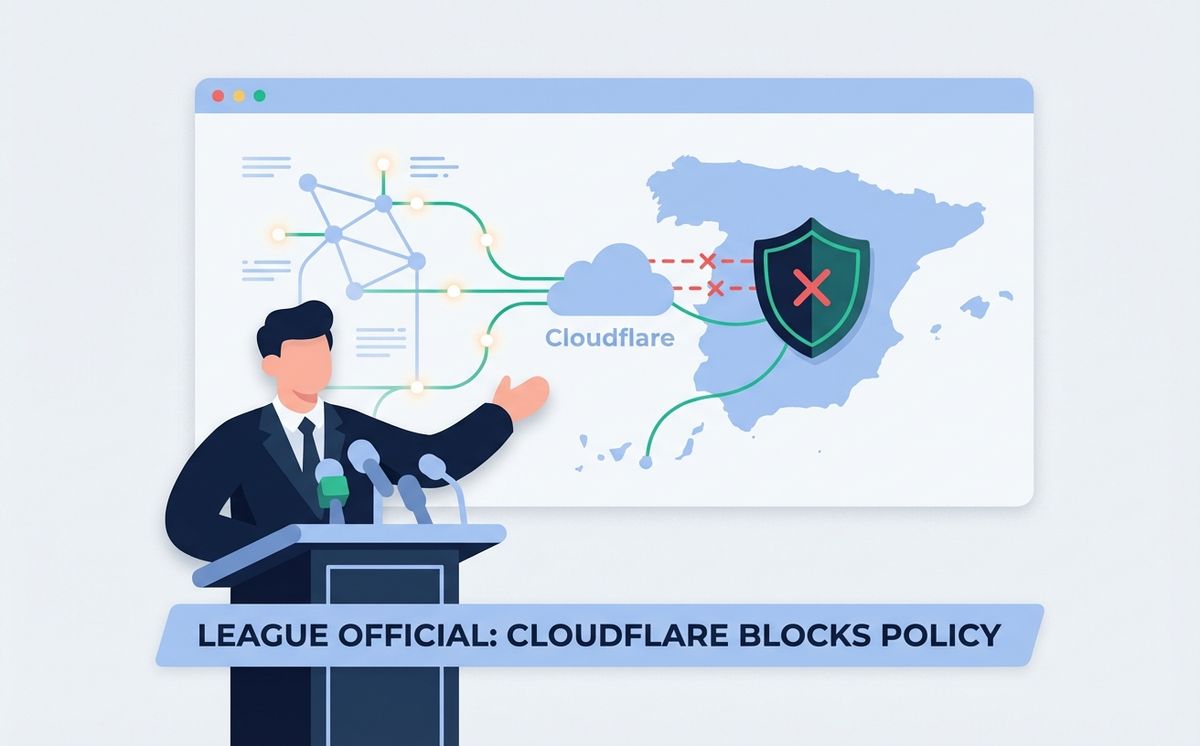
On 18 December 2024, the Commercial Court No. 6 of Barcelona issued a ruling that gave La Liga (and Telefónica) a new tool: whenever there’s a live match, they can ask Spain’s major internet providers (Movistar, MasOrange, Vodafone, DIGI) to block certain internet addresses.
The stated goal is to cut off access to websites that illegally broadcast football. The problem is the tool chosen to do it.
Cloudflare is an American company that manages approximately 20% of the world’s internet traffic. It is not a piracy host. It’s the infrastructure that underpins a huge part of the legitimate internet: online shops, media websites, payment platforms, and services of every kind.
When La Liga asks for a Cloudflare address to be blocked, that address is shared by hundreds or thousands of completely legal websites and services. Blocking it to cut off access to a piracy site is like cutting the electricity to an entire apartment building because someone in one flat is watching a match without paying.
In a single weekend of matches, more than 130 Cloudflare addresses have been documented as blocked in Spain. Each of those addresses serves hundreds of businesses that have done nothing wrong.
You’re Not Alone: Who Gets Hit When There’s a Match
When Spain Cloudflare blocks kick in, the list of affected services looks nothing like a list of piracy sites:
| Service | What it does |
|---|---|
| Payment systems (Redsys, PayPal) | Processing card payments |
| Real Academia Española | Spain's official dictionary |
| GitHub | Core working tool for developers |
| Steam | Legitimate gaming platform |
| Twitch | Licensed streaming service |
| Professional network | |
| Crunchyroll | Paid streaming platform |
| GPS apps for the elderly | Locating relatives with dementia |
Cloudflare’s CEO, Matthew Prince, put it bluntly: *”I pray no one dies.”* That’s not an exaggeration. The GPS applications that families use to track elderly relatives with dementia run on Cloudflare’s infrastructure. When there’s a La Liga match, those apps lose connectivity.
Adriana runs Lymo3D, a jewellery business using 3D printing. She doesn’t broadcast football. She doesn’t pirate anything. But her losses from weekend blocks amount to around €1,000 per month. Every Saturday with a match, her shop goes down. Customers can’t buy. Ad spend evaporates without any return.
“It’s hard enough being self-employed,” she told eldiario.es.
Kike, owner of Nueve Pies surf school in Cádiz, spent an entire month trying to understand why his website was crashing every weekend. When he finally figured it out, he had to pay €300 for a migration and switch to a more expensive hosting plan. Costs he should never have had to bear.
David Laguillo, editor of Cantabria Diario, saw his website and radio station go offline from 9 February 2025. He lost advertising revenue, closed his physical premises, and saw his reputation damaged by an association — entirely undeserved — with illegal content.
José Manuel Louro runs Ralight Solutions, an online gaming shop. During one weekend of blocks he had to restart his systems 14 or 15 times. The result: he sold more units than he had in stock and faced complaints from customers who never received their orders. “It’s an absolute helplessness,” he said.
The damage is not hypothetical or marginal. It’s real, documented, and repeats every weekend there’s a La Liga fixture.
Who’s Behind It: La Liga, Tebas, and the Conflict of Interest
To understand why this keeps happening, you need to understand who’s behind it and what’s driving each party.
Javier Tebas, president of La Liga, has been on a long crusade against football piracy. His argument has some basis: there are services that illegally broadcast La Liga matches, and that represents massive losses for the clubs. According to Tebas, Cloudflare acts in bad faith because it knows its infrastructure serves pirated content and does nothing about it. At one point during the controversy, he called Cloudflare’s CEO a “criminal.”
So far, it’s a debatable argument. What follows is harder to defend.
The irony of 2025: in August, ElEspañol revealed that La Liga uses Cloudflare’s own services to host and distribute its anti-piracy campaign. The organisation that has spent months demanding Cloudflare be blocked for being “the digital shield of pirates” uses exactly that same infrastructure for its own content.
Telefónica is the elephant in the room. It’s not just the company executing the blocks as a provider. It’s also the claimant in the court proceedings. And it’s also the owner of Movistar+, which holds the football rights in Spain. The company that benefits most financially from football being expensive and piracy-free is the same company that controls which websites get blocked and when.
That conflict of interest should be at the centre of the public debate. It isn’t.
Why Spain Cloudflare Blocks Don’t Stop Piracy
Here’s the central problem with La Liga’s strategy: it doesn’t work.
The services that illegally broadcast football are not companies with fixed offices and a technical team. They’re highly agile operations that can switch providers, move their servers to another country, or use intermediaries in a matter of hours. A weekend block gives them, at most, two extra hours of work. Then they’re back.
Reality confirms this week after week: Spanish users report that piracy football services haven’t missed a single match since the mass blocks began. The only ones that fail are legitimate businesses. Precisely those with real customers, contracts to fulfil, and a reputation to protect.
It makes complete sense when you think about it: piracy sites are flexible by design. Your online shop or business website can’t afford that kind of flexibility. Every minute your site is down costs you real money.
Does it make sense to use a strategy that doesn’t hurt its target but destroys the innocent? As an anti-piracy tool, no. But it does make sense if the real goal is to keep football expensive and without competition.
If your business depends on online services and you want to know exactly what risk you’re carrying, we audit your tech stack and tell you what to do. For more on digital infrastructure risks, see our cybersecurity analysis.
Spain Cloudflare Blocks: International Outrage and Government Silence
Outside Spain, the case has a very clear reputation: a textbook scandal. A post on HackerNews, the global tech community’s reference platform, reached 1,109 points and 407 comments within 24 hours. Theo, creator of t3.gg with hundreds of thousands of followers, summed it up: *”Spain’s egregious Cloudflare blocks are breaking Docker now.”*
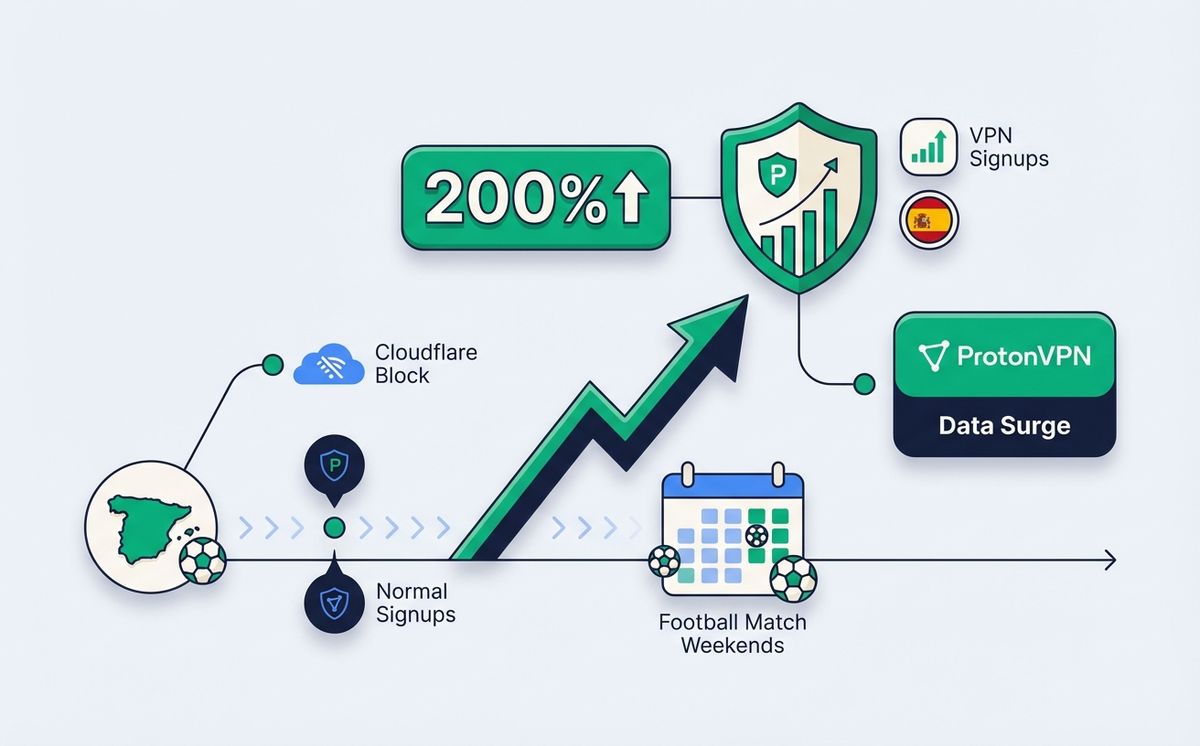
ProtonVPN published a full analysis of the phenomenon. Their free sign-ups in Spain jumped 200% on a match weekend — not because people wanted to pirate football, but because freelancers and professionals needed a way to keep working.
Cloudflare sued La Liga for “disproportionate blocking practices” and filed a formal complaint with the United States government. Their argument: Spanish courts are being used to obtain orders that are far too broad, going well beyond protecting copyright.
There’s even a website, hayahora.futbol, that shows in real time whether a La Liga match is currently in progress. The fact that website is necessary says everything about the situation.
Meanwhile in Spain, the government and Parliament stayed silent. A proposal by the BNG to limit the blocks was rejected. PP and VOX argued that stopping them would amount to “inciting piracy.” The Ministry of Digitalisation and the CNMC made no statement about a debate directly affecting thousands of Spanish digital businesses.
Spain’s Royal Academy of Language (RAE) was unreachable during one match weekend. When someone pointed this out to Javier Tebas, he replied that the block “only affects a few people who look at the RAE on a Saturday.” That response captures the institutional attitude better than any analysis.
Cloudflare and cybersecurity organisation RootedCON have filed appeals with the Spanish Constitutional Court. The solution isn’t coming from inside the system that allows this.
The Solution Nobody Wants to Say: Make Football Cheaper
Football piracy is not a technical problem. It’s a pricing problem.
In Spain, watching La Liga requires Movistar+ through Telefónica. There’s no affordable “football only” option. Nothing comparable to Spotify’s pricing. Football in Spain is expensive, concentrated in one operator — and that operator is the same one controlling the blocks.
The precedents are plentiful. When Spotify arrived with €9.99 per month for the entire music catalogue, music piracy collapsed. Not because they shut down The Pirate Bay, but because paying stopped being worth avoiding. Netflix did the same with TV series in its early expansion years — until it raised prices and banned shared accounts, at which point piracy immediately rebounded.
The Premier League has more international distribution deals at more varied price points. Comparative piracy of English football in Spain is notably lower than that of La Liga.
If football in Spain cost €5 a month with an app that actually worked, a significant fraction of current piracy users would pay. Not all of them — but enough to make the piracy business nonviable.
Instead, La Liga and Telefónica have chosen a strategy that destroys digital infrastructure, damages thousands of innocent businesses, and week after week fails to make the pirates miss a single match.
What You Can Do While Spain Cloudflare Blocks Continue
While the Constitutional Court deliberates, while the government continues to do nothing, and while La Liga keeps requesting blocks every match weekend, you have practical options:
- Check for a match before debugging: the site hayahora.futbol shows in real time whether a La Liga match is on. If your services fail on a Saturday afternoon, check there first before calling your developer or chasing a bug that doesn’t exist.
- VPN: ProtonVPN, Mullvad and similar services route you outside the reach of the blocks. ProtonVPN has a functional free tier for personal and professional use.
- DNS change: Using 1.1.1.1 or 8.8.8.8 as your DNS can bypass some blocks that operate at domain name level rather than IP address.
These are workarounds for a structural problem. But while the system doesn’t change, these are the tools you have. For more resources on protecting your business from external disruptions, see our tech strategy section.
If Spain Cloudflare blocks have affected your business and you want to know exactly what risk you face and how to reduce it, book a free call with LetBrand — no pitch, no commitment. We look at your stack and tell you exactly what to change.
Frequently Asked Questions about Spain Cloudflare Blocks
Why does my website go down on Saturdays and Sundays in Spain?
If your website uses Cloudflare — directly or indirectly through your hosting or platform — it may be affected by the blocks La Liga requests during matches. The internet address your website uses is shared by hundreds of other sites. When La Liga asks for that address to be blocked, your site goes down even though you’ve done nothing wrong. If you don’t know whether your hosting uses Cloudflare, our digital stack audits will tell you in detail.
How do I know if there’s a match and whether I’ll be affected?
There’s a website called hayahora.futbol that shows in real time whether a La Liga match is in progress. If the answer is yes and your services are failing, that’s the first place to look before calling your developer or spending hours searching for a non-existent bug.
Is using a VPN legal in Spain to avoid these blocks?
Yes. Using a VPN is completely legal in Spain for personal and professional use. You’re not accessing illegal content. You’re simply routing your connection through a server outside Spain to avoid the blocks La Liga imposes.
Can I claim damages if my business has been affected by the blocks?
Cybersecurity organisation RootedCON has published legal templates for those affected to file claims. The case is pending before the Spanish Constitutional Court. Consulting a specialist in digital law is the route to evaluate individual claim options.
What has Cloudflare done to defend its users in Spain?
Cloudflare has sued La Liga for “disproportionate blocking practices,” filed a formal complaint with the United States government, and lobbied publicly against the blocks. It has also denounced that La Liga used its abuse reporting system to send legal threats to completely innocent clients who had no connection to piracy whatsoever.
*Sources: HackerNews, Docker pull fails in Spain — Proton VPN, Spain Cloudflare Block — HackerNews, Cloudflare CEO: football piracy blocks will claim lives — eldiario.es — ElEspañol — Xataka — daniel.es/blog*
Related Posts

Agent skills are the open standard that works across Claude Code, GitHub Copilot, Gemini CLI, and 45+ AI agents. One file. Every tool. Zero repetition.
Read more
How does an LLM work, explained without jargon: books, tokens, maps of connections, and millions of corrections. Real examples for SME owners.
Read moreReady to start your project?
Let's talk about how we can help your brand grow with a personalized digital strategy.
Contact us