

Platforms
How Spotify Wrapped Works?
Why does your Wrapped say you love reggaeton if you're a rocker? Let me explain the engineering behind it: from Kafka and BigQuery to the 30-second rule.
 Adrian Sobota
How Spotify Wrapped works is the question flooding social media every December, usually accompanied by a screenshot and a message like: “This is wrong, I didn’t listen to Bad Bunny that much.”
I’m going to be brutally honest with you: your Wrapped isn’t lying. Your memory is.
What you see in those colorful stories isn’t magic, nor is it an intern choosing songs at random. It is the result of one of the most massive data engineering projects on the planet. We are talking about converting petabytes of raw logs—the digital trail of every time you pressed “play”—into a coherent visual narrative.
Let’s dissect the system. Forget the marketing and let’s look “under the hood”: Kafka pipelines, BigQuery aggregations, and business rules that decide your musical identity without asking for your permission.
The “Black Box”: Which Data Counts and Which is Ignored
To understand the result, you first have to understand the raw material. Spotify doesn’t “listen” to your music; Spotify records telemetry events. Your behavior is a log on a server.
From an engineering standpoint, your musical year is a collection of rows in a massive database. But here’s the catch: not everything you listen to ends up in the final summary. There are strict filtering rules that clean the noise before processing the signal.
The Golden Rule of 30 Seconds
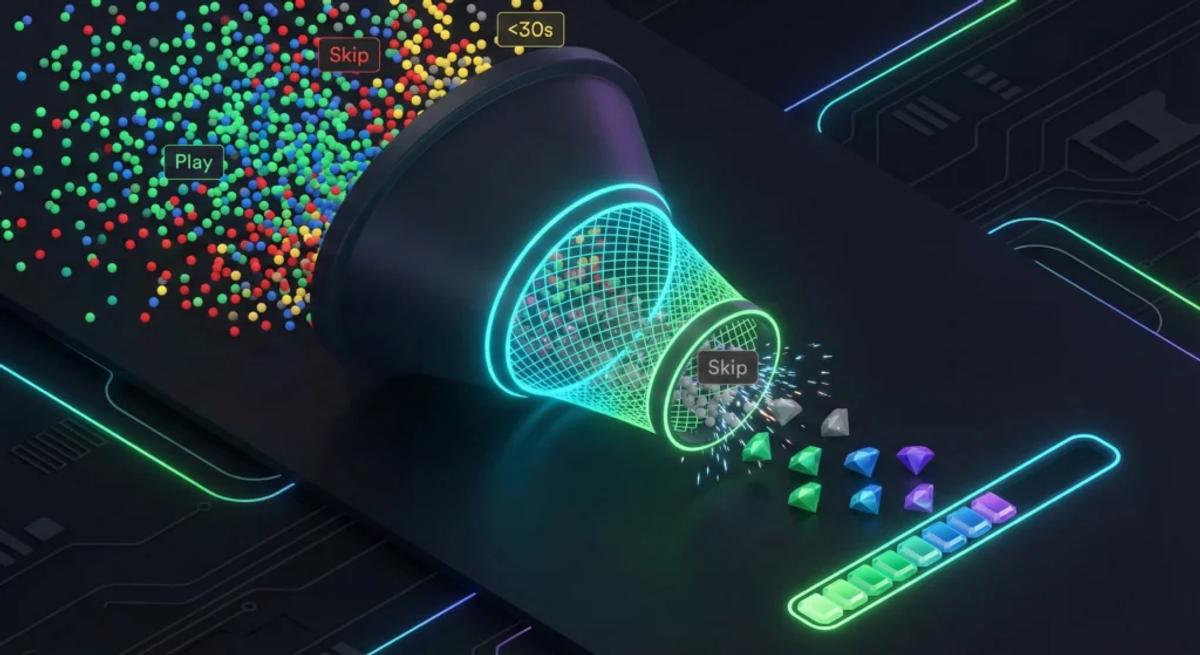
This is where most users get confused. You may have clicked on a song a thousand times, but if you skipped it at the 15-second mark because you got bored, to the system, that listen does not exist.
A valid stream is a playback that exceeds the 30-second threshold. Anything less is considered a “skip” or exploration, not real consumption. If you spend the day skipping songs, your “minutes listened” counter will be ridiculously low even if you’ve had the app open for hours.
The Myth of the “Full Year”: The Time Window
Why does that song you were obsessed with in December never appear in your Top list? Because Wrapped doesn’t cover the calendar year.
Data collection for Wrapped traditionally begins on January 1st and ends on October 31st (or early November in some recent years). This isn’t a whim. It is a technical necessity.
Note from the Data Architect: Processing the data of nearly 600 million users is not instantaneous. The engineering team needs that “buffer” of weeks to clean the data, detect anomalies (bots), run Machine Learning models, and pre-generate visual assets on CDNs so that on launch day, everything loads fast. If they counted until December 31st, you would receive your Wrapped in February.
Technical Architecture: How Petabytes of Noise are Processed
Imagine a pipe through which millions of liters of water flow per second. That is the Spotify backend.
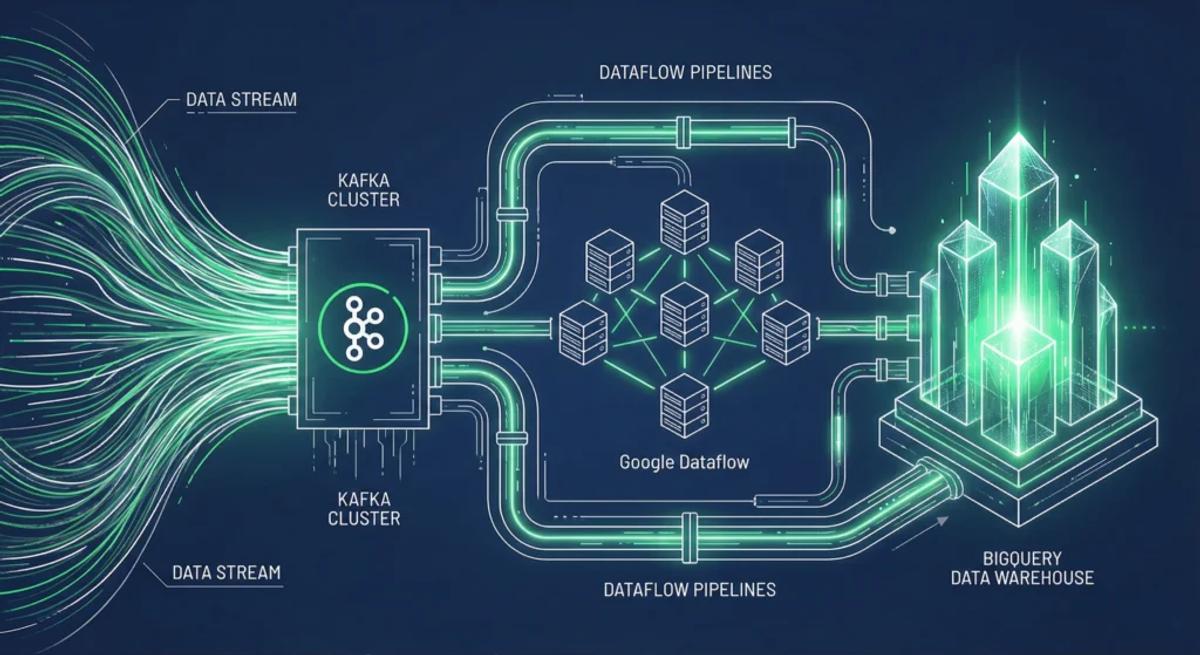
Every time you interact with the app (Play, Pause, Skip, Save, Share), an event is triggered. These events travel through a distributed messaging system, likely based on Apache Kafka. It is the central nervous system that takes the hit of real-time traffic without collapsing.
From Chaos to Order: Pipelines and BigQuery
Raw data is dirty. There are duplicates, offline listens that sync days late, and bot farms trying to inflate the numbers of certain artists. This is where pure Data Engineering comes in.
They use tools like Google Cloud Dataflow (Apache Beam) to create processing pipelines. The process looks something like this:
- Ingestion: Logs enter the system.
- Cleaning: Corrupt or fraudulent events are discarded.
- Enrichment: The song ID is crossed-referenced with the metadata database (Genre, Artist, Mood, BPM).
- Aggregation: Counters are summed up per user. Here they use techniques like Sort-Merge Bucket (SMB) to perform massive joins without spending a fortune on computing.
All this ends up stored in huge data warehouses (like BigQuery), where Data Scientists can launch massive SQL queries to extract the “insights” you later see on your screen.
Business Logic: Why Your Top 1 is Your Top 1
Many people believe their number 1 song is the one they played the most times. False. Or at least, imprecise. The reigning metric in streaming is not “Play Count” (number of times), but “Total Listening Time”.
Metric
What you think happens
How it actually works (Engineering)
Top Song
The one I played the most.
Ranking based mainly on accumulated total minutes, filtering streams < 30s.
Top Album
The record that has my favorite song.
Prioritizes “depth”. An album where you listen to 5 different songs will beat one where you only repeat the “hit”.
Genres
Rock, Pop, Indie.
Clustering of micro-genres (there are thousands: “Escape Room”, “Bubblegrunge”) based on user similarity graphs.
Incognito Mode
Spotify doesn’t count it.
Correct. The “Private Session” sets a flag on events so the aggregation pipeline discards them from the public profile.
The Favorite Album Case
This point causes friction. Imagine you love song “X” from album “A”. You listen to it 500 times. But from album “B” you like all the songs and play it in the background while working. Even if no song from album “B” is your top 1, album “B” will win the Album of the Year award.
The algorithm rewards retention and exploration within the container (the album), not just the obsession with an individual track.
Machine Learning: Understanding Your Musical “Aura”
Beyond counting minutes, Spotify tries to understand who you are. This is where Machine Learning and Audio Signal Processing come in.
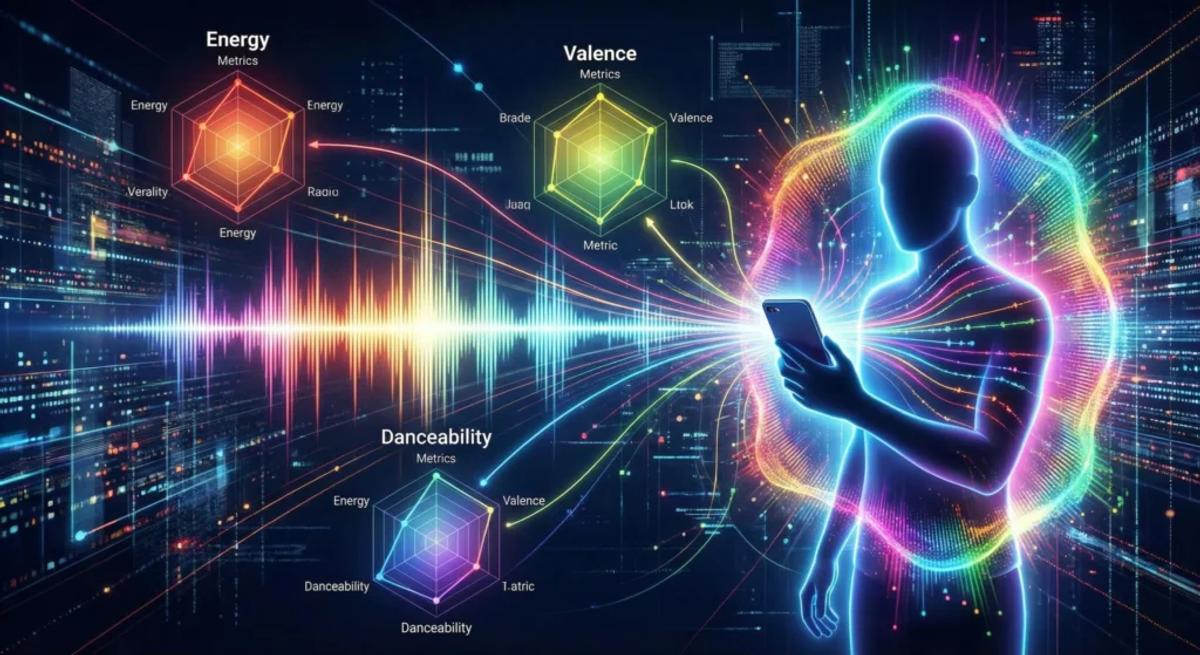
Every song in their catalog has a sonic fingerprint. They analyze:
- Valence: Is the song happy or sad?
- Energy: Is it intense or relaxed?
- Danceability: How easy is it to dance to?
- Acousticness: Real instruments or synthetic?
When Wrapped tells you that your “Musical Aura” is “Melancholy and Adventurous,” what it has done is average the Valence and Energy vectors of your top tracks and map them to a predefined quadrant. It’s not a horoscope; it’s vector algebra applied to your feelings.
Real Case: Ana and the “White Noise Effect”
Let me tell you about the case of Ana (fictional name, real situation). Ana is a developer and uses Spotify to concentrate. She listens to “Lofi Beats to Study” playlists for 8 hours a day. But on weekends she is a Heavy Metal fanatic.
The problem: Ana expects her Wrapped to say “Metalhead”. The data reality: Her Wrapped says her top genre is “Lofi Hip Hop” and her top artist is an unknown beat maker.
Why? Pure data volume. 40 weekly hours of Lofi statistically crush 4 hours of Metal. The algorithm doesn’t judge “quality” or “emotional preference,” it measures behavior. To correct this, Spotify engineers have had to implement specific filters for certain functional genres (like white noise or rain sounds) so they don’t cannibalize the summaries, but it is a constant battle.
The Frontend Challenge: D-Day
All this processing happens weeks in advance. The day Wrapped comes out, the app isn’t calculating anything in real-time. If it did, the servers would melt in minutes.
What happens is a massive static deployment. Your summary has become a lightweight JSON file, pre-cached on a CDN (Content Delivery Network) near your geographic location.
When you open the app:
- The mobile client requests your configuration.
- It downloads the JSON with your stats (Top 5 artists, minutes, etc.).
- The mobile rendering engine (using native components and libraries like Lottie) takes those numbers and paints the animations on the fly.
It is an illusion of dynamism. The videos, background music, and templates are already downloaded; your phone just fills in the gaps with the numerical data.
Checklist: How to “Hack” your next Wrapped
If you want to control what appears next year, you must play by the engineer’s rules, not the music lover’s:
- Use “Private Session”: Activate it whenever you play music for sleeping, studying, or for your kids (Baby Shark ruins algorithms).
- Beat the 30 seconds: If you are exploring new artists, give them at least half a minute if you want it to count as a positive interaction.
- Offline Downloads: Connect to the internet at least once every 30 days. Otherwise, the logs cached on your device might expire or not sync in time for the October cutoff.
- Be careful with Podcasts: Sometimes podcast minutes inflate the “total time” but don’t affect the musical “genre map” in the same way.
Frequently Asked Questions about How Spotify Wrapped Works
Does Wrapped count what I listen to offline? Yes, but with nuances. The application saves logs locally on your device. The next time you connect to the internet, it performs a “batch upload” of those events. If you listen to music offline on October 30th and don’t connect until November 2nd, that data will likely be lost for that year’s cutoff.
Why does Apple Music Replay update every week and Spotify doesn’t? It is a product decision, not a technical one. Apple bets on a continuous dashboard. Spotify bets on the virality of the “annual event.” Spotify could show you Wrapped in real-time (in fact, there are third-party websites that use their API to do so), but they withhold the information to generate scarcity and anticipation.
Do local artists or files uploaded by me count? Usually, no. Wrapped is based on IDs from Spotify’s official catalog. If you listen to local MP3s that you have synced with your mobile (“Local Files”), the system usually doesn’t have enough metadata to classify them in global rankings or assign them to specific genres.
It’s not your taste, it’s your footprint
At the end of the day, understanding how Spotify Wrapped works is an exercise in digital humility. The algorithm is an unfiltered mirror. If your summary seems embarrassing or inaccurate, remember that the system only aggregates what you have given it.
It is a masterpiece of Big Data packaged in bright colors for you to share on Instagram stories or via WhatsApp with your favorite group chats. And it works.
And you, knowing now that October is the limit, are you going to change what you listen to today, or are you going to let the algorithm surprise you again? We are clear that the fun of Wrapped is surprising yourself.
Ready to start your project?
Let's talk about how we can help your brand grow with a personalized digital strategy.
Contact us